
The Trade Sequence for Australian Home Renovations
The trade sequence for Australian home renovations: what every homeowner needs to know before work starts.
Most people planning a renovation in Australia have no trade background. This is the complete renovation sequence, what happens in what order, and the mistakes that cost the most when homeowners do not know it before they start.
One of the most common questions in Australian renovation communities is also one of the most important: what order do the trades come in?
It is not a silly question. It is the question that separates a renovation that runs to budget from one that does not. And yet it is almost never answered clearly before work starts.
Most Australian homeowners have no trade background. They are managing busy lives, families, and jobs while also trying to coordinate a renovation project with multiple tradespeople, a fixed budget, and no experience of how construction actually works. The knowledge gap between what the homeowner knows and what the trade on the other side of the table knows is where most of the expensive mistakes happen.
Knowledge is power in a renovation. Not confidence. Not luck. Knowledge. Specifically, knowing the right order before work starts.
This is the complete trade sequence for an Australian home renovation, from the decision to renovate to the day you hand over the final payment.
Why most budget mistakes happen before a trade arrives
The renovation budget mistakes that cost Australian homeowners the most are almost never caused by dishonest trades. They are caused by homeowners who did not know the right order, did not have the right documents, and did not know what to check at each stage before approving the next one to start.
If you are doing an online home renovation course, looking for a home renovation course, or simply trying to understand the process before your renovation starts, the most important thing to learn is the sequence. Get the sequence right and almost every other decision becomes easier.
Every trade who walks on to your renovation already knows the correct sequence. They know which stage has to come before theirs. They know what documents should exist at each point. You are the only person on that site who does not have this knowledge by default. This guide closes that gap.
The complete renovation trade sequence: all 20 stages
The renovation sequence is divided into four phases. Each phase has to be substantially complete before the next one begins. This is not optional. The sequence is not flexible. Every stage that happens in the wrong order costs money to undo.
Phase 1: Before a single trade is called (6 stages)
This is the phase that busy homeowners most often rush or skip entirely. It is also the phase that determines whether every quote you receive is fair, comparable, and pricing the renovation you actually want.
Stage 1 The Decision
Define the goal, the scope, and whether you are self-coordinating or engaging a builder before anything moves. A vague brief produces vague quotes. Vague quotes become the most expensive renovation mistakes.
Stage 2 Property Assessment
Inspect the property like a builder before your budget is set. Licensed building inspector, pest inspection, and for any property built before 1990, an asbestos assessment is mandatory before any demolition. What is behind your walls changes every number in your budget.
Stage 3 Budget and Planning
Set a realistic budget with a contingency of 10 to 15 percent built in as a planned line item. Every renovation finds something that was not visible before demolition started. The homeowners who plan for it manage it. The ones who do not have a crisis.
Stage 4 Design and Selections
Lock every fixture and finish before the scope is written. Tiles, tapware, cabinetry, appliances, flooring, paint colours. Every item with a brand, model, colour and price confirmed in writing. Vague selections become variations. Variations become invoices you did not budget for. This is one of the most consistent renovation budget mistakes for busy homeowners managing a project alongside everything else in their lives.
Stage 5 The Scope of Works
The scope of works is the document every trade prices from. It covers inclusions, exclusions, compliance requirements, how variations are handled, and what payment is tied to which stage. Without a scope, each trade prices their version of your job. With a scope, they price your job. That difference is thousands of dollars on almost every renovation.
Stage 6 Getting and Comparing Quotes
Three quotes minimum, all from the same scope. When they come back, do not compare the totals. Compare what each trade has and has not included. The cheapest quote is almost never the cheapest renovation.
The renovation that finishes on budget is not the one that found the best tradies. It is the one that was managed with the right knowledge before the first tool was picked up. Rob Smylie, Smart Renovators Academy
The complete trade sequence. 20 stages. In the right order.
An interactive digital guide for Australian homeowners. Every stage tells you what to do, which trade does it, what to check, and what to collect before the next stage begins. $17. Instant access.
Get The Renovation Roadmap for $17 → Works on any device. Progress saves automatically. No trade background needed.Phase 2: Appointing trades and starting on site (3 stages)
Once you have chosen your trades, these three stages set the legal and physical foundation before demolition begins. Rushing these is one of the most common renovation mistakes Australian homeowners make, often because no one tells them these stages exist.
Stage 7 Contracts and Appointments
Every trade on a written contract before any work begins. Not a text message. Not a verbal agreement. A contract that attaches the scope, states the itemised price, ties payment to inspected stages, specifies how variations are handled in writing, and defines the defect liability period. Any trade who resists putting these things in writing is a trade who expects conversations later that you will not enjoy.
Stage 8 Site Establishment
Protect areas not being renovated. Confirm skip bin location. Brief all trades on site rules. Permits displayed. For pre-1990 properties, asbestos clearance confirmed before anything starts.
Stage 9 Demolition
Licensed plumber and electrician make safe all services before any walls are touched. Photograph everything demolition reveals, date-stamped. Every pipe, wire and structural element. This is your evidence if a variation is disputed later.
Phase 3: Behind the walls (2 stages)
This is the part of the renovation trade sequence that most homeowners with no trade background know least about. It is also where the most expensive and irreversible mistakes happen.
Stages 10 and 11 cannot be undone without full demolition. Once walls close and tiles go down, any defect behind them is a demolition job to fix. Both stages require inspection and certification before the sequence can continue.
Stage 10 Rough-ins
Plumbing, electrical and structural blocking goes inside walls and floors before sheeting. Before any wall closes, you walk through the site and check every pipe position, every electrical point, and every noggin (the horizontal timber blocks inside walls that give you something solid to fix wall-hung items like towel rails, vanities and shower screens to) against your locked selections.
Once the wall closes, any defect behind it requires opening the wall to fix. This inspection is your last chance to see everything before it becomes invisible and expensive.
Stage 11 Waterproofing
Before a single tile is laid in any wet area, waterproofing must be applied and certified to Australian Standard AS 3740. The compliance certificate must be in your hands before the tiler starts.
Waterproofing failure discovered after tiling means every tile comes off. The substrate is inspected, the membrane reapplied, and tiles go back on. Every cent of that cost is yours if you let the tiler start without seeing the certificate. No certificate. No tiling.
Full critical checkpoint guides for rough-ins and waterproofing.
The Renovation Roadmap covers the two stages that cannot be undone in full. What to inspect, what the certificate must say, and what must be in your hands before any trade moves forward. $17.
Get The Renovation Roadmap for $17 → 20 stages. Every checkpoint. Instant access on any device.Phase 4: Finishes and sign-off (9 stages)
Phase 4 covers tiling, plastering, painting, cabinetry, appliance installation, floor coverings, fit-off, practical completion and final payment. Nine stages from tiling through to handing over the last dollar. The most common mistakes in this phase are approving a stage before checking it against the agreed scope, and releasing final payment before every defect is fixed and every certificate is in hand.
Stage 20 Practical Completion and Final Payment
Walk through the completed renovation with your scope of works. Record every defect in writing. Hold final payment until every defect on the list is rectified and re-inspected, and every compliance certificate is in your hands.
Your leverage is highest before work starts. It disappears the moment you release final payment. The practical completion walk-through is your last moment to hold it. Use it.
Knowledge is power in your renovation
The renovation sequence described in this guide is what every building professional already knows. It is the knowledge that site managers, builders and experienced tradies bring to every project they work on.
For Australian homeowners, especially those managing a renovation alongside a busy life and family commitments, the same knowledge has historically only been available the hard way. On your first renovation. When it is already costing you.
Online home renovation courses exist to close this gap. The right renovation education gives you the same knowledge the professionals have, before your renovation starts, so that you are not the only person on site who does not know what should happen next.
That knowledge is what prevents the common costly mistakes. The variation that should have been in the scope. The waterproofing that was never certified. The payment released too early. None of these are bad luck. They are all knowledge gaps.
The Home Renovation Course: prevent every costly mistake, from the first quote to the final payment.
The Renovation Roadmap gives you every stage in order. The Home Renovation Course gives you the full build management system behind every stage: the videos, the documents, the checklists and the frameworks that Rob uses on a real Australian build. Knowledge is power before your renovation starts. This is how you get all of it.
- 17+ video modules covering every renovation stage in detail
- Complete multi-room Scope of Works document ready to hand to trades
- Renovation Budget Tracker covering every quote and payment
- Stage Inspection Checklists for every phase including rough-ins and waterproofing
- Practical Completion guide for the final sign-off and payment release
- Designed for Australian homeowners with no trade background
Rob Smylie, Smart Renovators Academy
Rob has spent more than 20 years managing construction and renovation projects across Australia. Smart Renovators Academy was built on the belief that the knowledge which protects your renovation budget should not sit locked inside a site manager's head. It should be yours, before your renovation starts.

Meet Rob,
Hi, I’m Robert - and if you’re here, it’s probably because you already know that renovating a home is far more complex than most people are prepared for.
I’ve spent over 20 years in the construction industry - starting on the ground as a labourer, moving through carpentry, and into site management.
I’ve worked hands-on with bricklayers, plumbers, plasterers, and electricians, and I still stay on the tools today.
Week after week, I see good people make costly decisions with incomplete information - trusting advice they don’t fully understand, or finding out too late how something should have been done.
Smart Renovators Academy exists because the gap between what homeowners are told and how construction actually works on site is where most renovation problems begin.
This isn’t a DIY course.
You’re not here to pick up tools - your trades do that.
You’re here to understand the process, the standards, and the decisions that protect your budget, your timeline, and the final outcome.
One mistake in a bathroom or kitchen can easily cost more than this entire program - and those mistakes usually happen before anyone realises there’s a problem.
Inside the Academy, we start right at the beginning - mapping out what your renovation should look like before the first hammer falls — then we move into the highest-risk areas of any home: bathrooms and kitchens.
Everything here is based on real site experience. No theory for the sake of it. No sales talk. Just practical, tradie-level knowledge translated into clear language you can actually use.
You can move at your own pace, use the checklists and guidance to stay in control of your renovation, and learn what should be happening at every stage - not after the damage is done.
If you want clarity instead of guesswork - and confidence instead of crossed fingers - you’re in the right place.


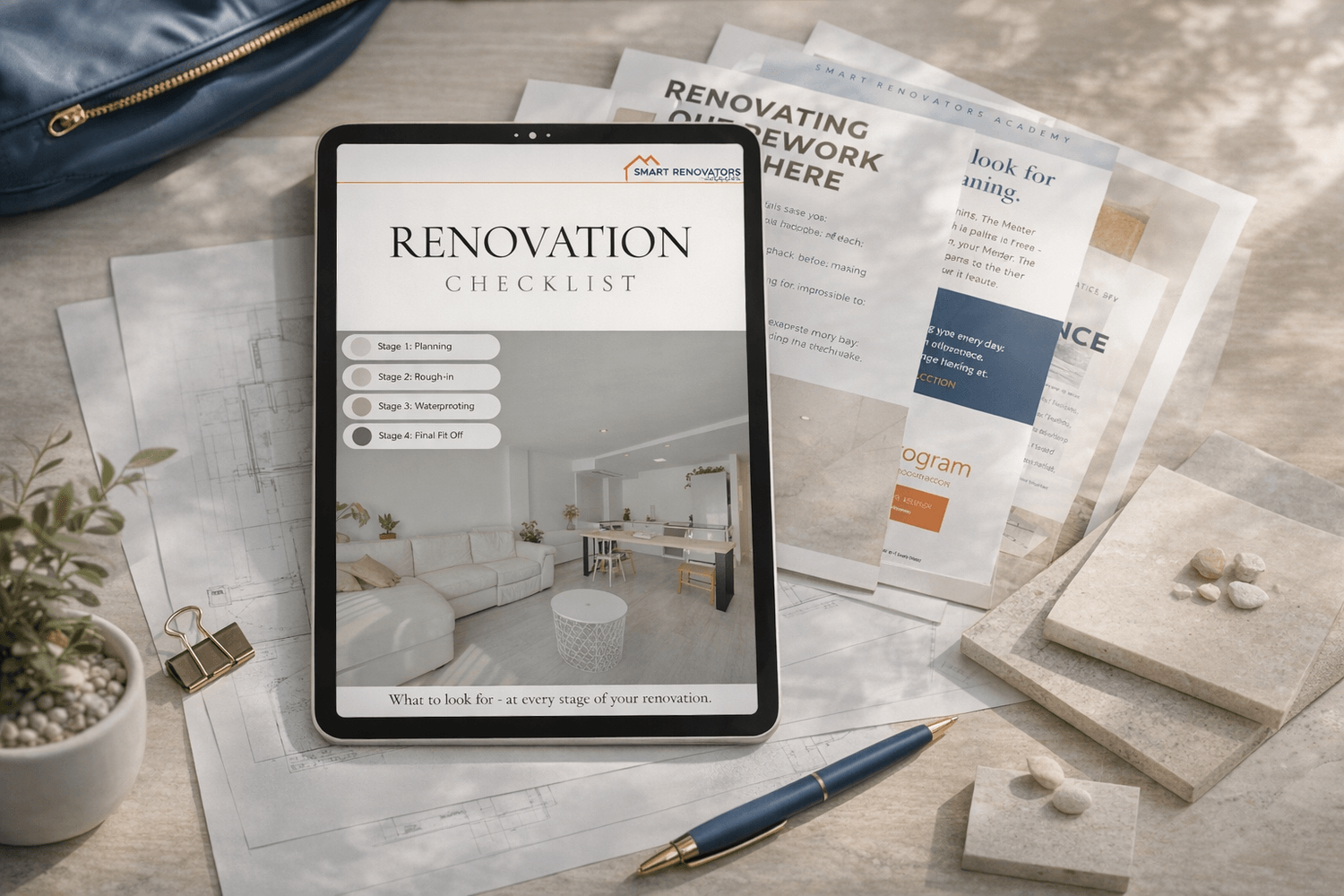
Save Thousands With This Simple FREE Checklist
SMART RENOVATORS ACADEMY